



By now, most ecommerce teams have already reviewed their holiday sales results.
Revenue is tallied, growth is compared year over year, and Cyber Week performance has been dissected in detail. For many brands, the 2025 holiday season looked strong by those measures.
U.S. ecommerce sales grew again. Demand arrived earlier than expected and stayed elevated longer. Promotions performed the way they were supposed to. From a distance, the season delivered the outcome most teams were planning for.
What those sales reports do not answer is a different question, and it’s one that tends to surface only after the noise settles when ecommerce fulfillment performance is evaluated more closely. Did the fulfillment system actually scale with that demand, or did it quietly compensate for strain until the season ended?
For growing brands, that difference matters more than it might appear at first glance.
Revenue growth can hide fulfillment strain.
Holiday demand in 2025 did not follow a clean spike-and-drop pattern. For many teams, volume stayed elevated across Cyber Week and Black Friday, creating a longer period of sustained pressure than most fulfillment systems are designed to handle. Industry data showed peak days reaching three to four times normal daily order volume, and in many cases, that intensity lasted well beyond a single weekend.
Sales reports capture the outcome of that demand. They do not capture how the system behaved underneath it.
Orders can continue to flow even when fulfillment performance begins to slip. Ship times stretch slightly, inventory confidence narrows, and additional labor gets layered in to protect service levels. Expedited shipping becomes more common, often without much discussion. None of that immediately interrupts revenue, which is why growth can look healthy even as operational risk quietly accumulates.
By the time those issues become obvious, peak has passed and attention has already shifted to the next priority.
Where ecommerce fulfillment performance actually shows up.
Ecommerce fulfillment performance rarely shows up clearly in revenue dashboards. It tends to appear in variation rather than outright failure.
Same-day and 24-hour ship rates may hold for a few days before drifting as volume stays high. Delivery windows widen even though carrier networks haven’t changed. Inventory buffers deplete faster than planned, and recovery takes longer than expected. These are subtle signals, but they are consistent ones.
In 2025, mobile commerce continued to account for more than half of online holiday purchases, raising expectations for fast confirmation, accurate delivery promises, and consistent updates. At the same time, buying behavior became harder to smooth, with demand compressing into shorter, less predictable windows. For fulfillment systems, that combination left little margin for error.
Many operations made it through peak. Fewer did so without adjusting how the system worked along the way.
The cost impact often appears later.
One reason fulfillment issues are easy to miss during peak is timing. The cost impact usually trails the volume.
Late deliveries increase customer service volume and compensation costs. Inventory inaccuracies lead to reships and refunds. Overtime labor pushes cost per order higher, often incrementally enough that it doesn’t trigger immediate concern. Carrier surcharges start to feel routine. Holiday return rates, which industry estimates placed near eighteen to twenty percent, add reverse-logistics pressure while outbound volume is still high.
None of those factors change how much was sold. They change how profitable that volume actually was. For most teams, that becomes clearer in Q1, when financials are reviewed without the urgency of peak influencing every decision.
Peak season exposes system limits, not effort gaps.
Peak season doesn’t create new problems so much as it reveals how systems behave when demand stays high and variability increases.
Forecasting gaps become more visible as volume accelerates faster than expected. Warehouse layouts that work well under normal conditions begin to show friction when throughput remains elevated for weeks at a time. Labor models built around steady flow struggle when order profiles shift daily instead of weekly.
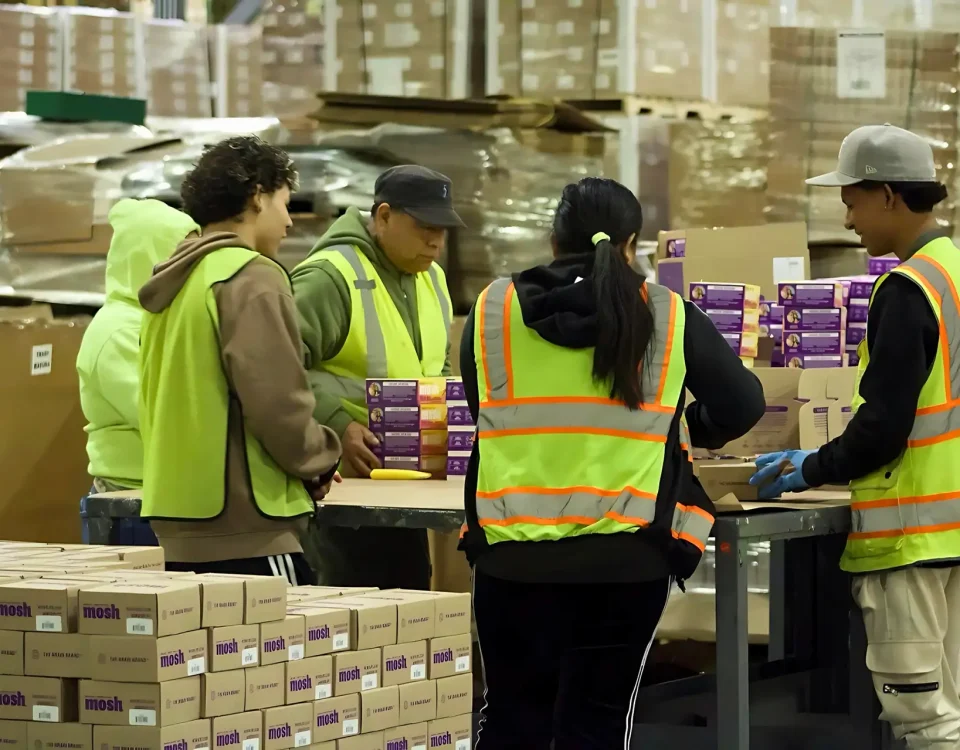
Value-added services tend to amplify these pressures. Kitting, labeling, compliance steps, and client-specific workflows add complexity at the exact moment speed matters most. Many brands found they could move standard orders efficiently while specialized workflows slowed the operation as a whole.
These outcomes are rarely the result of poor execution. More often, they point to system constraints that only become clear under sustained load.
What scaling brands should review in Q1?
Q1 is the first point at which ecommerce fulfillment performance can be evaluated with some distance. Volume has normalized, data from peak is complete, and the pressure to keep orders moving has eased enough to see patterns that were easy to miss in the moment.
For growing brands, the most useful review focuses less on averages and more on consistency. How long did peak volume stay elevated compared to baseline? How did same-day, 24-hour, and 48-hour ship rates perform across the entire peak window, not just the best days? How much variability existed in order-to-delivery time? How quickly were errors identified and resolved? How much unplanned labor or expedited shipping was required to maintain service levels?
Taken together, those metrics help answer a simple but important question. Did the fulfillment system scale with demand, or did it rely on short-term adjustments to get through the season?
Why is Q1 the decision window?
Decisions made in Q1 tend to shape how the next peak will feel. This is the period when fulfillment partners can be evaluated without urgency, processes can be adjusted without disrupting active volume, and assumptions can be tested against real data rather than forecasts.
Waiting until later in the year often means carrying forward the same constraints and hoping they hold. Reviewing fulfillment performance now creates space to address risk before it becomes embedded in the next growth cycle.
Real success shows up in predictability over time. Orders move consistently even when volume stays high, service levels hold under pressure, and costs remain aligned with plan rather than creeping upward. In those cases, the fulfillment system is supporting growth, not quietly absorbing strain in the background.
If topline results looked strong but raised questions once peak ended, Q1 is the right time to answer them. A focused ecommerce fulfillment performance review can surface what sales reports leave out and provide clarity as you plan for the year ahead.
When evaluating fulfillment partners, a structured 3PL RFP can help reveal whether a provider has the infrastructure, systems, and operational discipline required to scale with demand rather than compensate for it.

At IDS Fulfillment, we deliver accurate, scalable fulfillment solutions that help mid-sized ecommerce and multi-channel brands succeed across the U.S. From omnichannel order fulfillment to returns processing, our experienced team combines flexible logistics systems with real-time visibility to protect your customer experience and support growth. Backed by decades of operational expertise and powered by DHL Supply Chain’s infrastructure, IDS helps businesses scale with confidence, control costs, and meet delivery expectations every time.